Diisopropylamine CAS#108-18-9
Important Chemical Intermediate: Diisopropylamine is widely used as a key intermediate in the synthesis of various chemicals, supporting numerous industrial and specialty chemical processes.
Efficient Catalyst for Chemical Reactions: It serves as an effective catalyst in the production of pesticides and pharmaceuticals, helping to improve synthesis efficiency and process performance.
Versatile Industrial Applications: Due to its reactive secondary amine structure, diisopropylamine is suitable for a broad range of chemical manufacturing and organic synthesis applications.
Reliable Physical Properties for Processing: As a colorless liquid at room temperature, diisopropylamine offers convenient handling and integration into industrial production processes.
Diisopropylamine CAS#108-18-9
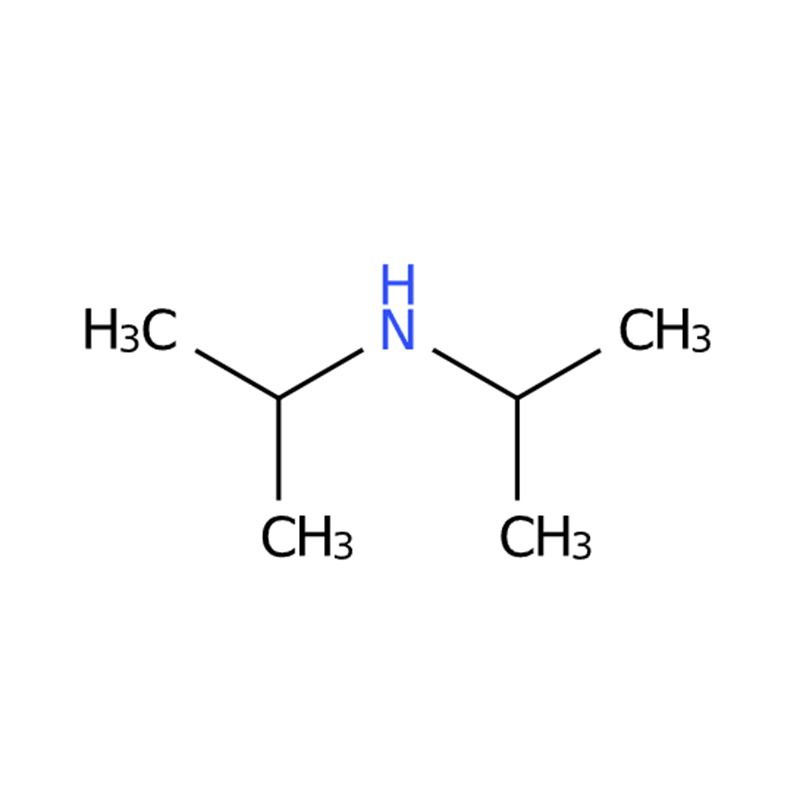
Diisopropylamine is a secondary amine that appears as a colorless liquid at room temperature and is characterized by a fishy, ammonia-like odor. It is widely used as a chemical intermediate and as a catalyst in the synthesis of pharmaceuticals and pesticides.
Diisopropylamine is also associated with tobacco products, where it may occur naturally in tobacco, be generated during the pyrolysis process in tobacco smoke, or be used as an additive in certain tobacco formulations.
Common alternative names for diisopropylamine include DIPA and N-(1-methylethyl)-2-propanamine.
Diisopropylamine Chemical Properties
| Melting point | -61 °C (lit.) |
| Boiling point | 84 °C (lit.) |
| density | 0.722 g/mL at 25 °C (lit.) |
| vapor density | 3.5 (vs air) |
| vapor pressure | 50 mm Hg ( 20 °C) |
| refractive index | n20/D 1.392(lit.) |
| Fp | 1.4 °F |
| storage temp. | Store below +30°C. |
| solubility | 100 g/L (20°C) |
| form | Liquid |
| pka | 11.05(at 25℃) |
| color | Clear colorless |
| PH | 11.8 (6g/l, H2O, 20℃) |
| Odor | Amine. |
| explosive limit | 1.1-7.1%(V) |
| Water Solubility | 100 g/L (20 ºC) |
| Merck | 143196 |
| BRN | 605284 |
| Exposure limits | NIOSH REL: TWA 5 ppm (20 mg/m3), IDLH 200 ppm; OSHA PEL: TWA 5 ppm; ACGIH TLV: TWA 5 ppm (adopted). |
| Dielectric constant | 3.04 |
| Stability: | Stable. Flammable. Incompatible with strong oxidizing agents. May react violently with strong acids or oxidizers. Air sensitive. |
| Cosmetics Ingredients Functions | BUFFERING |
| InChIKey | UAOMVDZJSHZZME-UHFFFAOYSA-N |
| LogP | 0.4 at 20℃ |
| CAS DataBase Reference | 108-18-9(CAS DataBase Reference) |
| NIST Chemistry Reference | 2-Propanamine, N-(1-methylethyl)-(108-18-9) |
| EPA Substance Registry System | Diisopropylamine (108-18-9) |
Safety Information
| Hazard Codes | F,C |
| Risk Statements | 11-20/22-34 |
| Safety Statements | 16-26-36/37/39-45 |
| RIDADR | UN 1158 3/PG 2 |
| OEB | A |
| OEL | TWA: 5 ppm (20 mg/m3) [skin] |
| WGK Germany | 2 |
| RTECS | IM4025000 |
| Autoignition Temperature | 599 °F |
| Hazard Note | Highly Flammable/Corrosive/Harmful |
| TSCA | TSCA listed |
| HS Code | 2921 19 99 |
| HazardClass | 3 |
| PackingGroup | II |
| Hazardous Substances Data | 108-18-9(Hazardous Substances Data) |
| Toxicity | LD50 orally in rats: 0.77 g/kg (Smyth) |
| IDLA | 200 ppm |
Product Application of Diisopropylamine CAS#108-18-9
Diisopropylamine is widely used as a solvent and as a reagent in the synthesis of dyes, pharmaceuticals, and various organic compounds. It serves as an important intermediate in numerous chemical synthesis processes.
It can be utilized in the preparation of compounds such as diisopropylamine methyl urea (DMU), N,N-diisopropyl quinoline-2-carboxamide, 3-N-sulfonylamidine coumarins, and N-chloroamines, which are key intermediates for the production of amides and other specialty chemicals.