

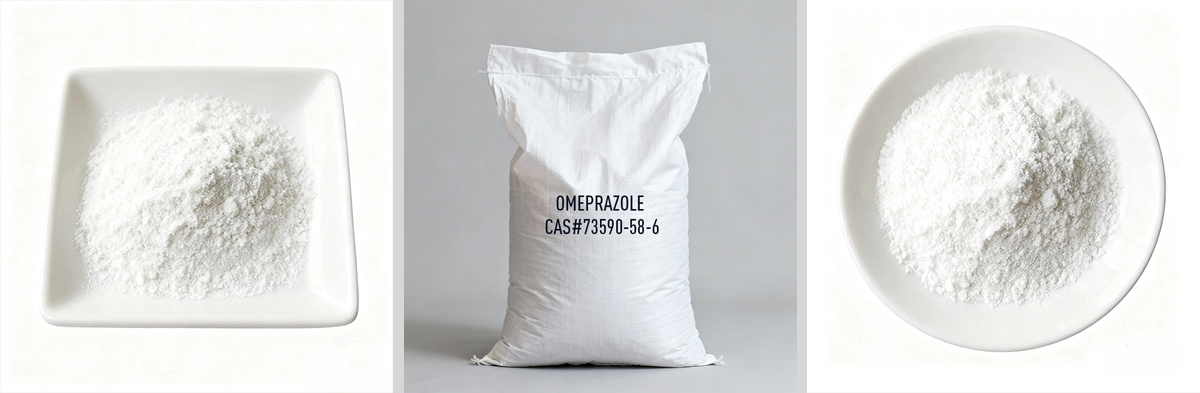
Omeprazole CAS#73590-58-6
Powerful Proton Pump Inhibition: Omeprazole specifically targets the proton pump (H⁺-K⁺-ATPase) in gastric parietal cells, effectively blocking the final step of gastric acid secretion.
Strong and Long-Lasting Acid Suppression: Through irreversible binding to the proton pump, it delivers a potent and sustained inhibitory effect on gastric acid secretion.
Broad Efficacy Against Multiple Acid Secretion Pathways: It effectively suppresses basal acid secretion as well as acid production induced by histamine, pentagastrin, and vagus nerve stimulation, including pathways not controlled by H2 receptor blockers.
Reliable Therapy for Acid-Related Disorders: The product is widely used for the treatment of peptic ulcers, GERD, and other acid-related gastrointestinal diseases, offering durable symptom control.
Products Description of Omeprazole CAS#73590-58-6
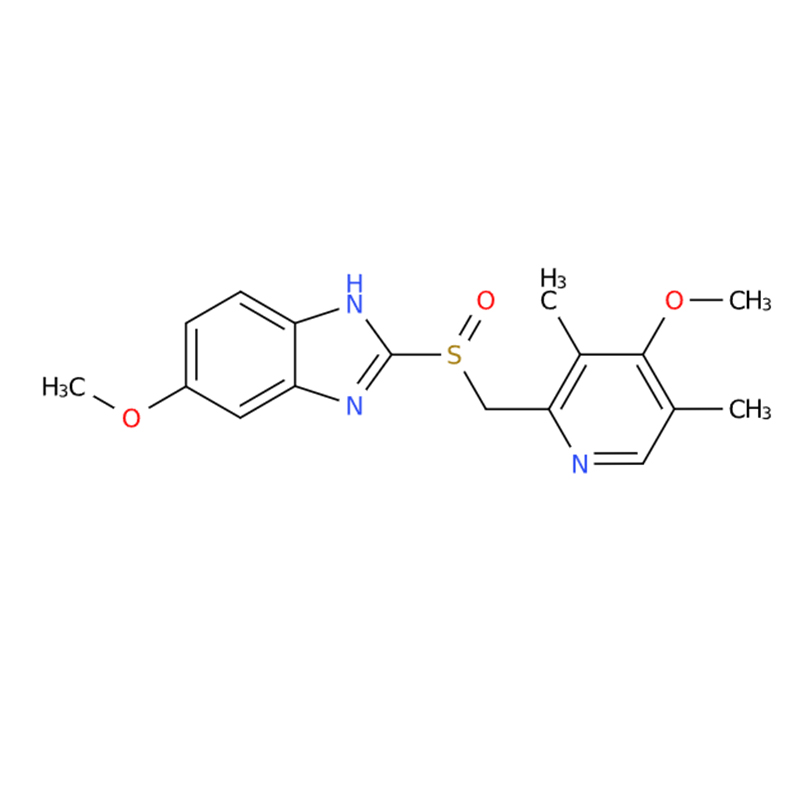
Omeprazole is a proton pump inhibitor used for the treatment of conditions such as peptic ulcer and gastroesophageal reflux disease (GERD). It acts specifically on proton pumps in gastric parietal cells and is converted into its active form, sulfenamide. The active sulfenamide then irreversibly binds to the sulfhydryl groups of the proton pump (H⁺-K⁺-ATPase), forming a stable complex that inhibits the enzyme’s activity. This prevents hydrogen ions in parietal cells from entering the gastric lumen, effectively blocking the final step of gastric acid secretion and significantly reducing gastric acid levels.
Due to its irreversible inhibition of the proton pump, omeprazole provides strong and long-lasting suppression of gastric acid, including basal acid secretion as well as acid induced by histamine, pentagastrin, and vagus nerve stimulation. It is also effective against acid secretion triggered by dibutyl cyclic adenosine monophosphate, which cannot be controlled by H2 receptor antagonists. Gastric acid levels are restored only after new proton pumps are synthesized.
Parameters
| Melting point | 156°C |
| Boiling point | 600.0±60.0 °C(Predicted) |
| density | 1.332 g/cm3 |
| Fp | 9℃ |
| storage temp. | 2-8°C |
| solubility | H2O: 0.5 mg/mL |
| form | solid |
| pka | pKa 4.14/8.9(H2O,t =25,I=0.025) (Uncertain) |
| color | white |
| Water Solubility | Soluble in water (0.5 mg/ml), DMSO (25 mg/ml), and ethanol (4.5 mg/ml). |
| Merck | 146845 |
| BCS Class | 2 |
| Stability: | Stable, but hygroscopic and photosensitive. Incompatible with strong oxidizing agents. Store in the dark. |
| InChIKey | SUBDBMMJDZJVOS-UHFFFAOYSA-N |
| CAS DataBase Reference | 73590-58-6(CAS DataBase Reference) |
| EPA Substance Registry System | 1H-Benzimidazole, 6-methoxy-2-[[(4-methoxy-3,5-dimethyl-2-pyridinyl)methyl]sulfinyl]- (73590-58-6) |
Safety Information
| Hazard Codes | Xi,T,F |
| Risk Statements | 36/37/38-39/23/24/25-23/24/25-11 |
| Safety Statements | 26-36-37/39-45-36/37-16-7 |
| RIDADR | UN1230 - class 3 - PG 2 - Methanol, solution |
| WGK Germany | 2 |
| RTECS | DD9087000 |
| HS Code | 29333990 |
| Hazardous Substances Data | 73590-58-6(Hazardous Substances Data) |
| Toxicity | LD50 in mice, rats (g/kg): 0.08, >0.05 i.v.; >4, >4 orally (Ekman) |

Product Application of Omeprazole CAS#73590-58-6
Used in the treatment of gastric and duodenal ulcers, as well as stress-induced ulcers.
Indicated for reflux esophagitis and gastrinoma.
Intravenous administration can also be applied for:
Gastrointestinal bleeding, including peptic ulcer bleeding and anastomotic ulcer bleeding, and for the prevention of upper gastrointestinal bleeding in severe conditions such as cerebral hemorrhage, major trauma, or post-gastric surgery.
Acute gastric mucosal injury caused by stress or non-steroidal anti-inflammatory drugs (NSAIDs).
Prevention of gastric acid reflux and aspiration pneumonia in patients after general anesthesia, major surgery, or in comatose conditions.
When combined with amoxicillin and clarithromycin, or metronidazole and clarithromycin, omeprazole is effective in eradicating Helicobacter pylori (H. pylori).
The pharmacological effects, synthesis methods, applications, and precautions of omeprazole are compiled by the Eastern Editor of Chemicalbook (2016-01-22).